
Old Testament Violence:
interpretive implications & week 21 readings.

Reading the Old Testament scriptures as a Christian, in these times, is perhaps especially challenging. As we live through the times of most grotesque violence against Palestine (versus the former, garden-variety violences) today, there was a celebration of sorts as the hopes and dreams of Palestinian children from Gaza have reached the top of the world. A kite bearing their handwritten messages of hope beyond their current circumstances was carried to the summit of Mount Everest by a team of mountaineers.

Finding hope, seeking hope in the midst of violence is hard work. As a small group of us continue our reading through the Bible in One Year project, one of the comments I have gotten back from readers regularly is about the violence in the Old Testament. I’ve been challenged to find hope within the violence described in some of these scriptures.
As Christians, we “inherit” the Old Testament or “share” these texts with our siblings in the Jewish faith. The Jewish faith is intimately tied with Israeli nationalism. But they are not one and the same.
So when we see news about Israel attacking other nations, there are often quick assumptions that these attacks are affirmed and supported by all Jewish people. This is absolutely not true. This youtube video offers a Jewish perspective that speaks eloquently against violence executed in the name of Judaism.
In the video, Rabbi Feldman of Neturei Karta articulates the differences between anti-Zionist and anti-Semitic movements: “Judaism is a religion, Zionism is a political movement". Christians who adopt a Zionist perspective would, by this definition, be drawing alongside a political movement, not the faith collective of our Abrahamic siblings who are Jewish.
I feel this is an important distinction to make: we can be faithful Christians and disagree with political decisions that involve violence, and even genocide. Indeed, as faithful Christians, I believe we are called to stand against injustice: by both Old and New Testament scriptures, we are called to stand against injustice. These words in the photo below, from Amos 5:24, speak about God’s power which will roll down powerfully against the people of Israel (“God’s people”) who are participating in unjust and oppressive acts, especially against the vulnerable.
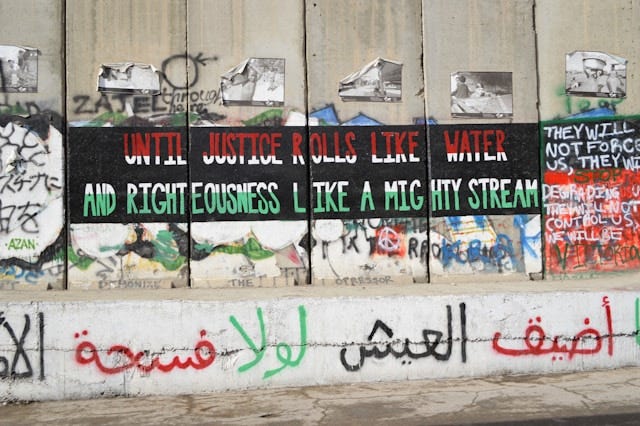
The scripture quote above is graffitied on the Israel Palestine wall. Words of scripture highlighting God’s desire for justice and righteousness painted on a physical separation of God’s people on either side of this wall.
So why am I wading into this particularly mucky pond of mis/understanding? Because I have two beliefs regarding scripture:
Scripture is provided for us, by God, through the smudgy hands of mere mortals, to engage and grapple with, even and perhaps especially when it is uncomfortable.
The work of interpreting scripture is not superficial work: where scripture challenges us, we need to examine our own deeply held worldviews and perhaps uproot some of the things that contravene God’s will for us (and woa, are there many and many of these).
So in my delayed reading of the Bible (I am a few weeks behind the week 21 readings which I offer up today in this post), I got to Deuteronomy 13 - a chapter in which God advises God’s people to kill all, destroy all who might pull them away from God’s commandments.
I immediately thought “Gee God, don’t you think death is a bit drastic here? Don’t you think killing ALL the citizens is (pardon the pun) overkill?” (Deuteronomy 13: 8-9).
But then, I thought again about the longer trajectory of time and history, and what has happened when the worship of other gods has been encouraged and pursued. For consumerism, colonization, rape of the earth, doctrines of power/wealth/greed - all these are the worship of other gods: the worship of gods of power and money/wealth and greed.
And I then thought what if, what IF when these ideologies were first being enacted, those who spearheaded them were stopped in their tracks? How would our world be different today?
I wondered, is God calling us into violence against other faiths? Or is God calling us into standing against values, systems and ways of living that ultimately bring us into lives that make following God’s commandments a distant goal? Following God’s commandments - even the ultrasimplified New Testament version:
love God with all your everything (heart, mind, soul, will)
love your neighbour as yourself
Following these commandments is challenged severely when maintenance of other systems is more important. Often maintaining other systems implicitly means loving ourselves less, causing a cascading effect of how we can love our neighbours and how much of self we have left with which to love God. Let me offer an example.
If I am preoccupied with maintaining a particular system or structure, here’s a close at hand one: church as we know it today, am I able to maintain that system and ALSO love God with all my everything, and ALSO love myself (ie care for myself, groom my own conscience carefully, bring before God my own rights and wrongs for corrections and improvements?), and ALSO love my neighbour as myself? Or will I become preoccupied so with the maintenance of church as I know it today that maintaining the most important commandments falls by the wayside? That caring for my community, falls by the wayside?
If the answer is yes, then the system ought to be uprooted, examined carefully, re-engineered perhaps to return to its original purpose: instrument to love and worship God and live out God’s will for our lives.
Is God really encouraging violence in those challenging Old Testament scriptures? Or is God inviting us to look at what needs to be harshly uprooted because it is poison for us: individually and as communities? I think it is way more the latter than the former, but it requires a deep engagement with God, scripture, others and self to see some of these scriptures as simply sanctioning things like, oh for example, Israeli violence against Palestine.
Interpretation of scripture is not a straight line process, and requires a willingness to examine our lenses very carefully. Often in community. And if I were not reading the Bible with a group of people who are asking these questions, faithfully and grappling to see the God of love they know in the midst of very challenging texts that seem to invite horrid violence, I probably would not have dug this deep.
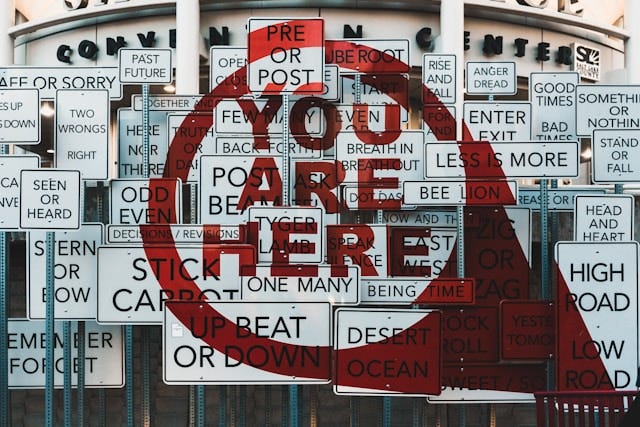
When I read the Deuteronomy 13 scripture with the lens of the many destructive systems, powers and principalities which have displaced God’s will for us today, and imagine what would be required to correct those destructions - the required changes are not small tweaks. They are massive uprootings which would feel like violence to the lives with which we have become familiar. And I do believe it to be God’s will that we be open to changing systems of oppression that are antithetical to loving God, loving ourselves and loving our neighbours as ourselves.
And loving ourselves is not about gaining power, wealth or ego boosts for ourselves.
With these reflections, I offer to you the Week 21 readings and a prayer:
Week 21 Readings:
Thursday May 21st : 1 Samuel 29:1 to 1 Samuel 31:13, John 11:55 to John 12:19, Psalm 118:1-20 and Proverbs 15:24-26
Friday May 22nd (we begin 2 Samuel): 2 Samuel 1:1 to 2 Samuel 2:11, John 12:20-50, Psalm 118:21-29 and Proverbs 15:27-28
Saturday May 23rd: 2 Samuel 2:12 to 2 Samuel 3:39, John 13:1-30, Psalm 119:1-16 and Proverbs 15:29-30
Sunday May 24th (Pentecost Sunday): 2 Samuel 4:1 to 2 Samuel 6:23, John 13:31 to John 14:14, Psalm 119:17-32 and Proverbs 15:31-32
Monday May 25th: 2 Samuel 7:1 to 2 Samuel 8:18, John 14:15-31, Psalm 119:33-48 and Proverbs 15:33
Tuesday May 26th: 2 Samuel 9:1 to 2 Samuel 11:25, John 15:1-27, Psalm 119:49-64 and Proverbs 16:1-3
Wednesday May 27th: 2 Samuel 11:26 to 2 Samuel 12:31, John 16:1-33, Psalm 119:65-80 and Proverbs 16:4-5
A Prayer for DEEP Patience with Scripture:
Holy Creator, inspiration behind all scripture - the included and excluded, please help us with deep patience as we read challenging things in our holy books. Help us to engage with voices that are different from our own in non-violent ways, that we might uproot false beliefs of following you, and plant deep the seeds of your truth and your desire for justice, righteousness and love. Amen.
Mount Everest Photo by Weichao Deng on Unsplash
Palestine Israel wall Photo by Ash Hayes on Unsplash
Complex decision-making Photo by Tim Mossholder on Unsplash